Peak: An Open-Faced Story Sandwich
(In which I invent the word 'sandwichality.')
by Ben Schneider
I want to talk about Peak. Maybe you've heard of it? Last year, my kids and I played a bunch of this delightful, hit "friendslop" indie title. We drew Bing Bong, the in-game mascot, everywhere. Broke dinner and bedtime rules to finish runs. Avidly followed updates. And, somewhere in that frenzy, a thought struck me.
The thought that Peak is a fantastic - if unlikely - vantage point for contemplating narrative in interactive media.
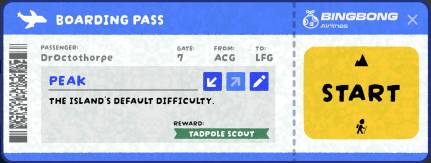
A one way ticket to fun and disaster.
In Peak, you are a Scout (the merit badge sash kind) who has survived a plane crash on a deserted island, and you have to climb the island’s (titular) peak, where rescue awaits. Which of course, is harder than it sounds. And weirder.
What works remarkably well about this is that straightaway you get it. The premise. The joke. What’s going on. What you’re in for. And if you’re anything like me, your reaction is a big old grin and a hell yes. It’s pretty plain why. We know these tropes. We know them like the backs of our gamepads. The stranding on a deserted island, first and foremost, in all its variations: shipwreck, plane crash, cannibalism, conversations with beachballs, the whole nine yards. We are so familiar with it all that Peak can cut straight from the airport lobby to the wreckage-strewn beach, no cinematics required.1 Layered on top are the neighboring tropes of scouting (khakis, campfires, can-do), rock climbing, and wilderness survival.
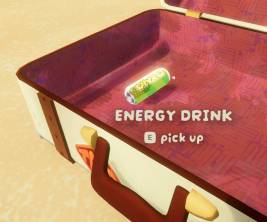
Beware the sugar crash.
This is some high-efficiency (not to mention budget-friendly) worldbuilding. We get a lot out of pretty much a hand-wave at those tropes. Let us count the ways. We don't just quickly grasp the situation, stakes, and goals. We also get a well-defined (cheerful, friendly, brave, prepared) role to play, a clear sense of what to expect out there, and what sorts of events may follow. The setting runs straight into gameplay, those ludic verbs and nouns snapping right into place. Items found scattered in plane crash-scattered suitcases rather than the conventional chests. Dangers manifested in flora and fauna that may or may not be at all safe to eat, climb, touch.
The fact that powerups come in the form of energy drinks, first-aid kits, and campfire marshmallows isn't just fun. These details put narrative marrow into the game's bones. They are precisely the way that narrative design (worldbuilding in particular) transforms gameplay into something more. Makes it coherent in a way that's immersive. Turns it from just a mechanical challenge into high adventure, into know-how and can-do in a pinch, into moments of pluck and eucatastrophe against overwhelming odds. Into living out Lost (do people remember that show?), or Survivor, or Lord of the Flies. Its tone and theme make it easy to swallow the supernatural, surreal, frustrating, and gamey that rise up to get in the way and make the play-parts fun.
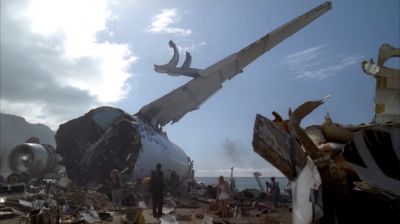
The show LOST. Is that the same plane? You decide.
Have I sold you on Peak’s worldbuilding yet? Deeply original? Yeah, nope. I doubt it was trying to be. A perfect fit and foundation for the game? Emphatically YES.
Okay, then. Let’s step back.
When you read a book, go to a play, get the latest on your crazy aunt’s drama with her landlord, the same narrative truth holds: the setting is, in a broad sense, behind the story you’re witnessing. On stage or screen, kind of literally so: the props and sets are arranged for actors to stand in front of. A little less literally, in all non-interactive media, you sip World through Story. You get only as much background, backdrop, and backstory as the camera and narrator give you, framed in the shot, dropped as an aside, inferred from context. In other words, story mediates world.
I think of it like this:
But that’s not quite how it goes in interactive formats, is it? We drop the player in the middle of, say, a tropical beach or a fantasy morgue, put a wooden sword in their hand, and let them verb directly at what’s around them, giving pretty much direct access to the narrative world (AKA setting) in the act.
In a profound sense, the player is in the driver’s seat here, formerly held by that camera or narrator. Even when the game is very on rails; even when we throw cutscene after cutscene at them; the player is still notionally at the center of it, likely deciding where to go, or at least where to point the camera and the pace at which things move forward. Anyway, regardless, somehow between the story and the world.
Something more like this:
Kind of an interactive narrative sandwich, where, instead of the story, it is the player who is the good stuff between the slices of bread.
This arrangement suggests a couple of interesting points. First, that whatever happens in a given playthrough is more genuinely the story than some planned and theorized plot arc. In a phenotype vs genotype sense, right? And that in turn raises a question: just how central is the player’s primacy (centrality? sandwichality?) in expressing an interactive story? For that matter, just how necessary is that top slice of bread?
Because if you stop and consider a moment, Peak hasn’t exactly got one.
It is, in fact, kind of an open-faced sandwich. There are no (or few) authorially imposed plot points beyond plane crashed and got rescued. Between those goalposts and atop the fertile field of the setting, the story is just… all the things that happened along the way. Driven entirely by the player, in the form of gameplay. The successes. The failures. The many awkward moments that aren’t quite either.2

Well SOMEBODY settled the PB vs J question to their satisfaction. (image source)
And I don't think you can reasonably argue that Peak isn't an intrinsically narrative-rich experience. Like I noted above: it's got that shit in its bones. Take that away and the game wouldn't be half what it is. Is it on the literary level of (topically) The Odyssey? Well, no. But its narrative cargo manifest does include a premise, theme, backstory, antagonists (eerie mist, 'The Scoutmaster', Nature), fun mysteries, dramatic stakes, even a flipping inciting incident. From there, rather than epic poem, it’s all Richard Linklater, with you starring as (take your pick) Julie Delpie or Ethan Hawke. If you accept the argument that the narrative of a playthrough is the playthrough (warts, detours, minigames, and all)3, Peak is a game with a narrative but no story. Or with a story but no plot. Or whatever. Pick your poison(-ous mushroom).
What we can take from this is: narrative is most evidently mediated by the player. World-building and plot in games and interactive fiction are not strictly tied together. And one of those two slices of bread is looking a lot more necessary than the other. You gotta have your setting (and, if you consider it distinct, a premise) to have a dramatic playable experience. But what is de rigeur in non-interactive narratives appears to be an optional article, a mere hat, here. Sometimes the hat makes the outfit. Other times, you do just fine without it.
I did not come here to throw shade at plot lines, though, but to shine light on worldbuilding and its importance in interactive storytelling. For one, you kind of need it to design and build the game in terms of art, mechanics, level design, and so on. See those suitcases, campfires, and other bits and bobs that make up Peak. But also, it serves another vital purpose - captured almost perfectly in the phrase “setting the stage” – for the player.
Sandwiches aside, if I could be allowed to scratch the turntables of metaphor here: the player is the lead actor of your play. And like the improvised cinema of Guest or Linklater (and rambling stories of your crazy aunt), they’ve got no script, no idea where this is going. In fact, they’ve done no prep whatsoever. They just waltzed onto the stage and began. Our jobs, as the designers of this drama, are to provide them with the props and costumes (the scout uniforms and first aid kits), supporting actors, and environmental cues that make them want to inhabit the role and play out the play. As if they themselves thought of it. With all the innocence and earnestness in the world, by and large entirely unconscious of, you know, any of this.
From that perspective, story – the classic plot arc kind – is only good insomuch as it guides, inspires, provokes, and prompts the player to inhabit that role and play to their fullest. Upstaging them, sidelining them, even running a teleprompter with killer lines... All this pales in comparison to the instant, inhabitable worldbuilding that shines so brightly in Peak.
 Easter egg beats cutscene. Them's the rules.
Technically, the load screen progress bar is rendered as the flight, but it doesn't reference the crash. Either way, it's a very light touch indeed.↩
Okay, so as of recently some lore and 'true' ending content have been added. At some point, I'm going to write a whole article about how lore or backstory is not the game's story. But for now, let me just say: lore and backstory are not the game's story!↩
Yet again, just smile and nod with me here: the story of the game is the story played.↩